
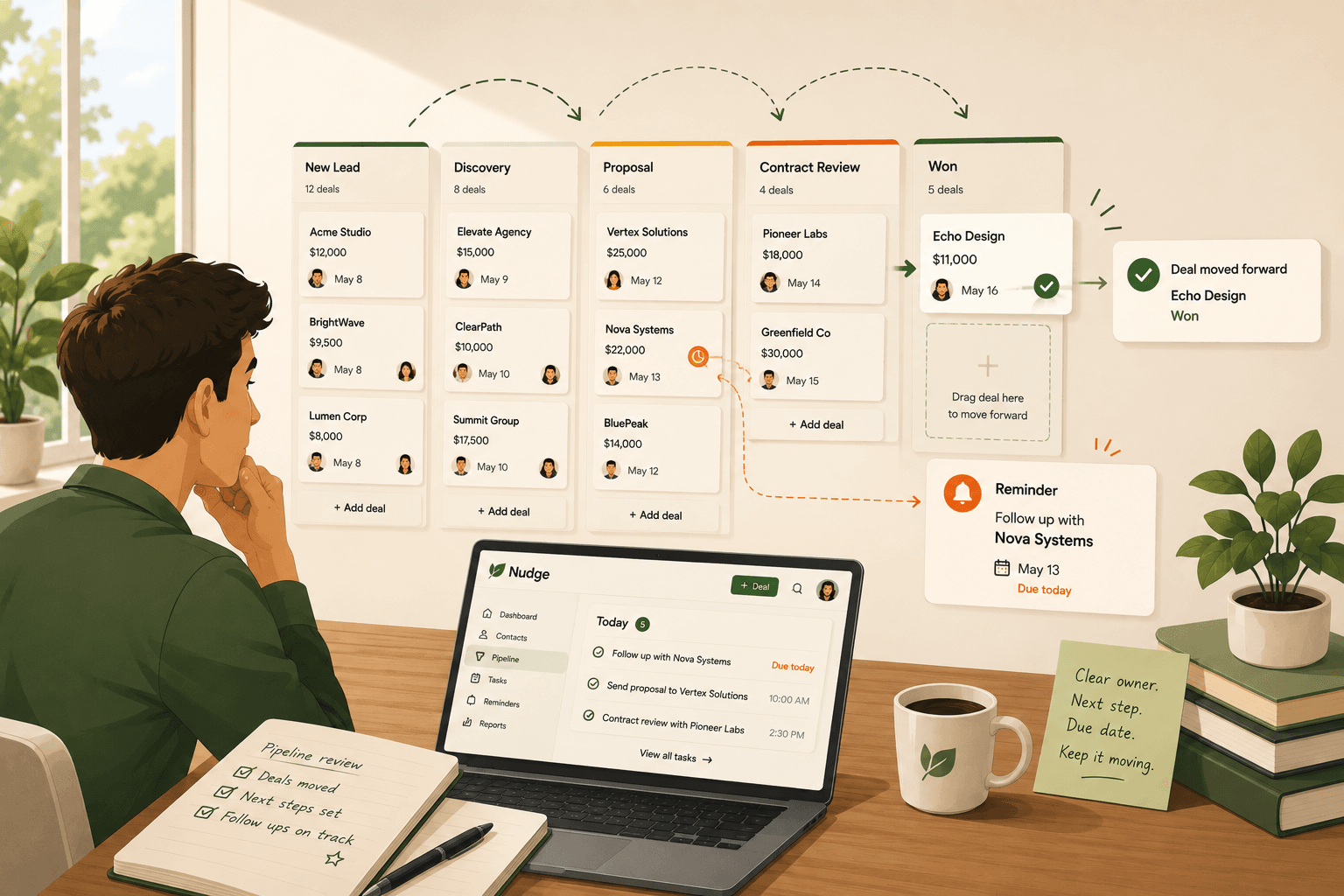
Every sales team has deals that should have closed.
The proposal was sent.
The customer was interested.
The timing felt right.
Then... nothing.
Nobody forgot on purpose. The follow-up just never happened.
That's the challenge with sales pipeline management. Deals rarely fall apart because of one big mistake. They slow down because the next step isn't clear, ownership becomes unclear, or follow-ups get buried under everything else your team is working on.
A healthy pipeline isn't about tracking more deals.
It's about making sure every deal keeps moving.
Focus on movement, not volume
A full pipeline can feel reassuring.
But a long list of opportunities doesn't tell you much if half of them haven't moved in weeks.
Instead of asking how many deals are in your pipeline, ask:
- Which deals moved this week?
- Which ones are waiting on a follow-up?
- Which opportunities haven't been updated recently?
Movement tells you far more about the health of your pipeline than volume ever will.
Make ownership clear
One of the fastest ways for a deal to stall is when nobody knows who's responsible.
Even in small teams, it's easy to assume someone else will send the email or schedule the next meeting.
Every opportunity should have one clear owner.
That doesn't mean they're doing all the work.
It means they're responsible for making sure the deal keeps moving.
Clear ownership creates accountability without creating extra meetings.
Every deal needs a next step
A pipeline tells you where a deal is.
It should also tell you what happens next.
If the only update on an opportunity is "Waiting for the customer," there's a good chance it will stay there longer than it should.
Instead, define the next action.
It could be:
- Schedule a discovery call.
- Send a revised proposal.
- Follow up next Tuesday.
- Prepare the contract.
Small actions create momentum.
Without them, even promising deals can quietly go cold.
Keep your pipeline simple
More stages don't always mean more visibility.
In fact, overly complicated pipelines often create confusion.
Your stages should represent meaningful milestones, not every task your team completes.
When everyone understands what each stage means, it's much easier to review opportunities, identify bottlenecks, and keep work moving.
Simple pipelines are usually healthier pipelines.
Review your pipeline every week
The best sales teams don't wait until the end of the month to clean things up.
They build a simple habit of reviewing the pipeline every week.
Not to check whether everyone updated the CRM.
To understand what's changing.
Ask questions like:
- Which deals moved?
- Which haven't?
- What's overdue?
- Does every deal have a next step?
Those conversations help you spot problems while there's still time to solve them.
How Nudge helps
Nudge was built around one simple idea.
Deals shouldn't quietly stall.
That's why every deal in Nudge requires:
- An owner
- A next step
- A due date
Instead of searching through reports or asking your team for updates, you can immediately see what's overdue, what's due today, and what needs attention next.
That means less time chasing information and more time moving deals forward.
The healthiest pipelines aren't the ones with the most opportunities.
They're the ones where every opportunity has a clear owner, a clear next step, and a reason to keep moving.