
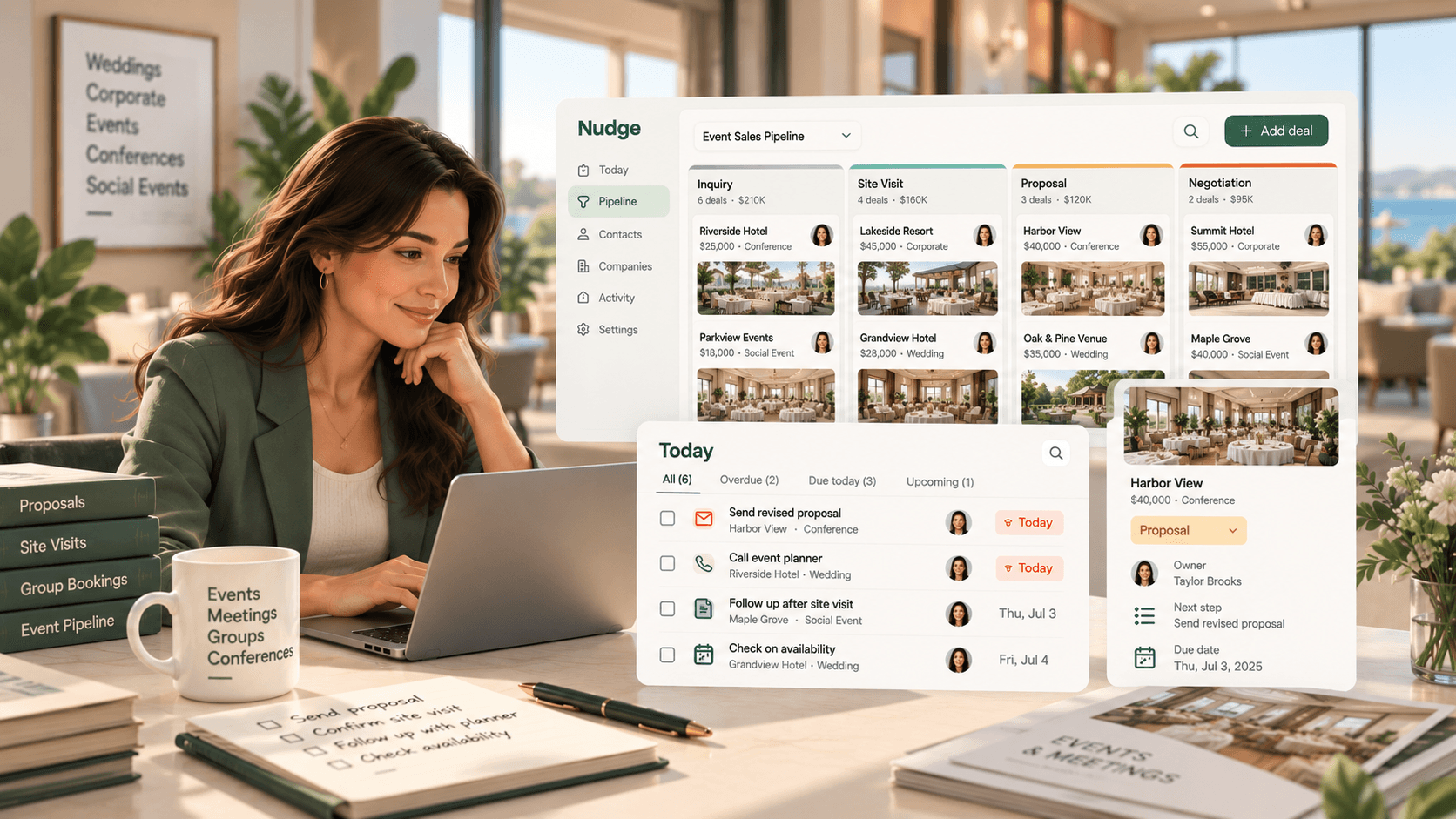
Hospitality sales rarely moves from inquiry to signed agreement in one conversation.
A corporate planner asks about dates and capacity. A couple tours a venue but wants time to compare options. A company requests a proposal for its annual conference. An event organizer likes the space but needs approval from someone else.
The opportunity is still alive.
But now someone needs to remember what happens next.
That is where hospitality sales can become difficult to manage.
Hotels, venues, and event teams often have many opportunities at different stages, each with different contacts, requirements, timelines, and follow-ups.
A CRM for hospitality sales should help the team keep those opportunities moving without forcing people to reconstruct every conversation from inboxes, notes, spreadsheets, and memory.
The goal is straightforward:
Every active opportunity should have a clear owner, a clear next action, and a date for when that action needs to happen.
Why hospitality sales is so dependent on follow-up
Hospitality sales is relationship-driven, but it is also timing-driven.
An inquiry might start months before an event.
Between the first conversation and a decision, the sales process can include:
- Initial inquiry
- Availability checks
- Qualification
- Site visits
- Proposal preparation
- Proposal revisions
- Internal approvals
- Contract discussions
- Final decisions
There can be long pauses between those steps.
Those pauses are where opportunities can quietly lose momentum.
A prospect may still be interested, but the team is waiting for them to respond.
A proposal may have been sent, but nobody has scheduled the follow-up.
A site visit may have gone well, but the next action exists only in someone's notes.
The challenge is not simply keeping a list of inquiries.
It is keeping track of what needs to happen next for each one.
What should a CRM for hospitality sales actually do?
Hospitality businesses already use software for many different operational needs.
A sales CRM has a different job.
It should help the team manage the relationship and sales process leading up to a decision.
For each active opportunity, your team should be able to answer:
- Who is the prospect or organization?
- What are they interested in?
- Where does the opportunity stand?
- Who owns the relationship?
- What has happened so far?
- What needs to happen next?
- When should that happen?
If those answers are scattered across different tools or people, follow-up becomes harder than it needs to be.
1. Give every inquiry a clear owner
Hospitality opportunities can involve several people.
One person responds to the original inquiry.
Another conducts the site visit.
A manager may become involved in pricing.
Someone else may prepare or revise the proposal.
Collaboration is useful.
Ambiguous ownership is not.
Every active sales opportunity should have one person responsible for making sure it continues moving.
That does not mean the owner does everything personally.
It means there is never uncertainty about who is responsible for making sure the next step happens.
For example:
Opportunity: Acme annual conference
Owner: Taylor
Stage: Proposal
Next step: Send revised proposal
Due: Thursday
Anyone looking at the opportunity can understand what is happening.
2. Build a pipeline around the actual sales process
A hospitality sales pipeline should reflect the meaningful steps between an inquiry and a decision.
For an event venue, a pipeline might look like:
New inquiry → Qualified → Site visit → Proposal → Negotiation → Contracted / Lost
A hotel handling group or corporate opportunities might use different stages.
That is fine.
The important thing is that each stage has a clear meaning.
If an opportunity is in "Proposal," the team should understand what has already happened and what typically needs to happen before it moves forward.
Avoid adding stages simply because you can.
The pipeline should help the team understand progress, not make the process harder to interpret.
3. Turn every open opportunity into a next action
A pipeline stage tells you where an opportunity stands.
It does not necessarily tell you what to do.
Consider:
Stage: Proposal
That tells the team a proposal is involved.
Now compare it with:
Next action: Call event planner Friday for feedback on revised proposal
The second version gives someone something to do.
Hospitality sales next steps might include:
- Confirm event requirements
- Schedule site visit
- Send availability
- Prepare proposal
- Send revised proposal
- Follow up after site visit
- Confirm decision timeline
- Answer catering questions
- Check on internal approval
- Follow up on contract
The next action should be specific enough that the owner does not need to reopen the entire opportunity just to decide what to do.
4. Put a date on the next step
"Follow up next week" sounds reasonable during a conversation.
By next week, it may be competing with twenty other things.
A next action becomes much more useful when it has a due date.
If a planner says their team will review the proposal on Wednesday, schedule the follow-up for an appropriate date after that.
If someone tours the venue on Friday, decide when the post-visit follow-up should happen.
If a prospect asks you to reconnect next month, put the date into the workflow now.
Not every opportunity needs action today.
Every active opportunity should have a clear point when it needs attention again.
5. Keep site visits connected to the opportunity
A site visit can be one of the most important moments in a hospitality sales process.
It can also generate information that is easy to lose.
The prospect might mention:
- A change in guest count
- A concern about layout
- A preferred date
- Additional space requirements
- Questions about catering
- Another decision-maker
- A revised budget
- A deadline for making the decision
If those details remain in someone's notebook, they are difficult for the rest of the team to use.
Record the important context with the opportunity.
Then define what happens next.
For example:
Site visit completed: Tuesday
Note: Client needs revised setup for 120 attendees
Next action: Send updated proposal and layout
Owner: Jordan
Due: Thursday
Now the site visit has resulted in a clear action rather than becoming another completed activity.
6. Keep the relationship history together
Hospitality sales opportunities can develop over weeks or months.
During that time, there may be calls, emails, meetings, site visits, notes, proposals, and internal discussions.
When those interactions are scattered, context becomes dependent on the person who remembers them.
That creates problems when someone else needs to step in.
Imagine a salesperson is unavailable and a prospect calls about a proposal.
Can another team member quickly understand:
- Who the prospect is?
- What they are planning?
- What has already been discussed?
- What was promised?
- When the last conversation happened?
- What is supposed to happen next?
A shared relationship history makes that much easier.
It also makes handoffs less risky when ownership changes.
7. Track the details that matter to your sales process
A hotel, conference venue, wedding venue, and event company may all need to track different information.
Depending on the business, useful sales information might include:
- Event type
- Event date
- Estimated guest count
- Company or organization
- Estimated opportunity value
- Space or room requirements
- Lead source
- Decision date
- Site visit date
- Event planner or primary contact
You do not need to track every possible detail.
The best fields are the ones that help your team qualify opportunities, prepare conversations, filter the pipeline, or decide what should happen next.
If nobody uses a field to make a decision, it may not need to be there.
8. Make today's priorities visible
A pipeline gives the team an overview of sales.
But a salesperson starting the day needs something more specific.
They need to know:
What requires my attention today?
That could include:
- An overdue proposal follow-up
- A site visit that needs confirmation
- A planner waiting for revised information
- An availability question that needs a response
- A prospect who should be called after reviewing a proposal
Without a clear daily view, salespeople have to scan the pipeline, inbox, calendar, and notes to reconstruct their priorities.
A stronger system brings those actions together.
A practical hospitality sales workflow
You can apply the same framework to every active opportunity:
Owner + next action + due date
For example:
Opportunity: Annual leadership conference
Stage: Site visit
Owner: Alex
Next action: Send revised meeting-room options
Due: Wednesday
Or:
Opportunity: Corporate holiday event
Stage: Proposal
Owner: Taylor
Next action: Call planner for proposal feedback
Due: Friday
Or:
Opportunity: Wedding reception
Stage: Qualified
Owner: Jordan
Next action: Confirm site visit
Due: Tomorrow
The details will change.
The structure stays consistent.
Someone owns the opportunity.
Something needs to happen next.
There is a date for when it should happen.
What happens when several people touch the same opportunity?
Hospitality sales is often collaborative.
That makes clear ownership even more important.
A sales manager might approve pricing. An event specialist might conduct the tour. Another team member might answer questions about the space.
All of those people can contribute without becoming the owner.
The owner remains responsible for making sure the opportunity reaches its next meaningful step.
If ownership does need to change, the handoff should include:
- Current stage
- Important relationship context
- Recent activity
- Next action
- Due date
Changing the name of the owner without transferring the next action leaves the opportunity vulnerable to the same ambiguity you were trying to remove.
A hospitality sales pipeline review checklist
A regular review does not need to become a long status meeting.
For each active opportunity, ask:
- [ ] Does the opportunity have an owner?
- [ ] Is it in the correct pipeline stage?
- [ ] Is the latest important activity recorded?
- [ ] Is there a specific next action?
- [ ] Does that action have a due date?
- [ ] Are any actions overdue?
- [ ] Has a site visit happened without a follow-up?
- [ ] Has a proposal been sent without a scheduled follow-up?
- [ ] Are we waiting on the prospect, or is there still something we should do?
- [ ] Should this opportunity still be active?
The goal is not to add more sales administration.
It is to identify opportunities that have stopped moving before they disappear from attention.
How Nudge supports hospitality sales
Nudge now explicitly supports hospitality sales teams, including hotels, venues, and events.
The product is built around the same follow-through framework:
Every deal has an owner.
Every deal has a next action.
Every next action has a due date.
For hospitality teams, that structure can be applied to inquiries, site visits, proposals, and other relationship-driven sales opportunities.
Nudge's Today list brings due, overdue, and upcoming work into one place so salespeople can see which opportunities need attention without repeatedly reviewing the entire pipeline.
Pipelines can be configured around the team's workflow, while custom fields can be used to track information relevant to the business.
The activity timeline keeps calls, emails, meetings, and notes together so the team can review the history of the relationship.
Nudge also supports email capture through a workspace dropbox, helping relevant sales conversations stay attached to the appropriate record.
For teams that need multiple workflows, Premium supports multiple shared and private pipelines.
Moving an existing hospitality sales list into Nudge
Many hospitality teams already have useful sales data before they start using a CRM.
It might live in a CSV, an Excel workbook, or another CRM.
Nudge supports spreadsheet and CRM imports so teams do not have to rebuild everything manually.
On Premium and during the trial, Nudge's AI-powered import supports CSV and XLSX files, including multi-sheet workbooks. It can suggest mappings for businesses, contacts, deals, activities, and custom fields, with a review step before the data is created.
Nudge also supports imports from Pipedrive, Zoho CRM, and OnePageCRM.
The point is to bring the relationships and opportunities you already have into a workflow where the next action is easier to see.
What Nudge is not trying to replace
Hospitality businesses often rely on specialized operational systems.
A sales CRM does not need to replace all of them.
Nudge is focused on relationship-driven sales and follow-up.
Use it to manage prospects, opportunities, conversations, ownership, next actions, and due dates.
Keep the specialized systems you rely on for other parts of the business.
That distinction is useful when evaluating any CRM for hospitality.
Do not ask whether one system can do everything.
Ask whether it improves the part of the workflow you are actually trying to fix.
What to look for in a CRM for hospitality sales
Before choosing a CRM, ask:
- Can every opportunity have a clear owner?
- Can we define the next action?
- Can we attach a due date to that action?
- Can salespeople quickly see what needs attention today?
- Can our pipeline reflect our actual sales process?
- Can we keep important relationship history together?
- Can we track the information relevant to our opportunities?
- Can someone else understand an account if the original owner is unavailable?
- Can we bring our existing sales data with us?
- Will the system help us follow through rather than create more administrative work?
A long feature list is not necessarily the answer.
The CRM should make the sales process clearer.
Keep the opportunity moving
Hospitality sales depends on relationships, timing, and consistent follow-up.
A strong first conversation matters.
So does the site visit.
So does the proposal.
But none of those moments guarantees that an opportunity will continue moving.
Someone still needs to own what happens next.
That is why a useful hospitality sales process comes back to three basic questions:
Who owns this opportunity?
What happens next?
When does it happen?
When those answers are clear, teams spend less time reconstructing the pipeline and more time moving opportunities forward.
That is the approach Nudge is built around.
If your hotel, venue, or event sales team needs a clearer system for follow-through, you can start Nudge with a 14-day free trial. No credit card is required.