
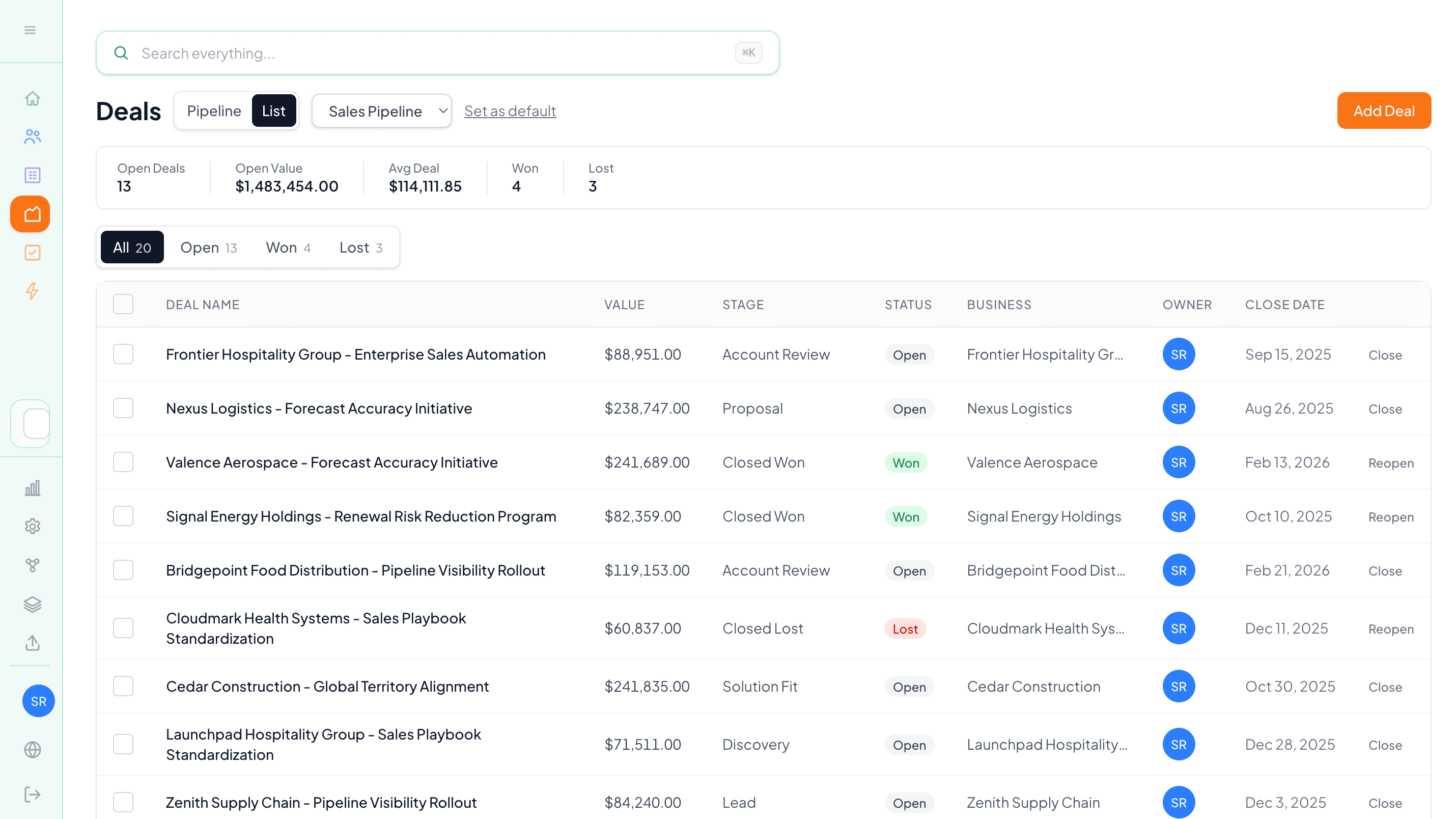
Every CRM has a probability field. It sits there next to each deal, quietly suggesting how confident you should feel about your pipeline. A deal in early discussions might show 20%. One in final negotiations might show 80%. The numbers feel scientific. They feel like signal.
They're mostly noise.
The problem with percentage-based forecasting
Sales forecast accuracy is a well-documented problem, and most organizations struggle with it more than they'd like to admit. The reasons tend to be the same across teams: outdated data, inconsistent usage, and a natural tendency for reps to be optimistic about their own deals. Deals stay marked as active long after a prospect has gone cold. Probabilities don't get updated because nobody owns that task. Stages mean different things to different reps on the same team.
The result is a pipeline that looks healthy until the end of the quarter, when reality arrives and the numbers don't add up.
There's also a deeper problem. A probability percentage tells you how a deal is doing. It doesn't tell you what to do next. A deal sitting at 60% could be actively progressing or completely stalled. You can't tell from the number alone, and the number doesn't help you figure it out.
Progress and probability are not the same thing
One of the most common mistakes in pipeline management is treating stage advancement as a reliable indicator of close likelihood. Moving a deal from "Proposal sent" to "Negotiation" feels like progress. But if there's no defined next step attached to that move, no owner, and no due date, the deal isn't really progressing. It's just been relabeled.
The assumption that all deals at the same stage carry the same probability ignores everything that actually determines whether a deal closes: who you're talking to, how engaged they are, whether there's a real decision-maker involved, and whether anyone is actively moving it forward.
What actually moves deals forward
The honest answer is straightforward: consistent, timely follow-up with a clear next step.
Not a percentage. Not a stage name. A specific action, assigned to a specific person, with a specific due date.
When every deal has a defined next action and someone responsible for it, you don't need to estimate probability. You can see directly what's moving and what isn't. A deal with an overdue follow-up is a deal at risk. A deal with a next action due today is a deal in progress. That's more useful information than any percentage.
How Nudge approaches it
Nudge doesn't ask you to assign a probability to your deals. Instead, it requires a next action, an owner, and a due date on every deal in your pipeline.
Your Today list shows what's due, what's overdue, and what's been done. Pipeline reviews become a conversation about next steps rather than a debate about whether a number should be 60% or 70%.
It's a simpler system, and it reflects how deals actually get closed: not by updating a field in a CRM, but by following through consistently until the deal moves or it doesn't.
Start your free trial and see what your pipeline looks like when it's built around actions, not estimates.
-- The Nudge Team