
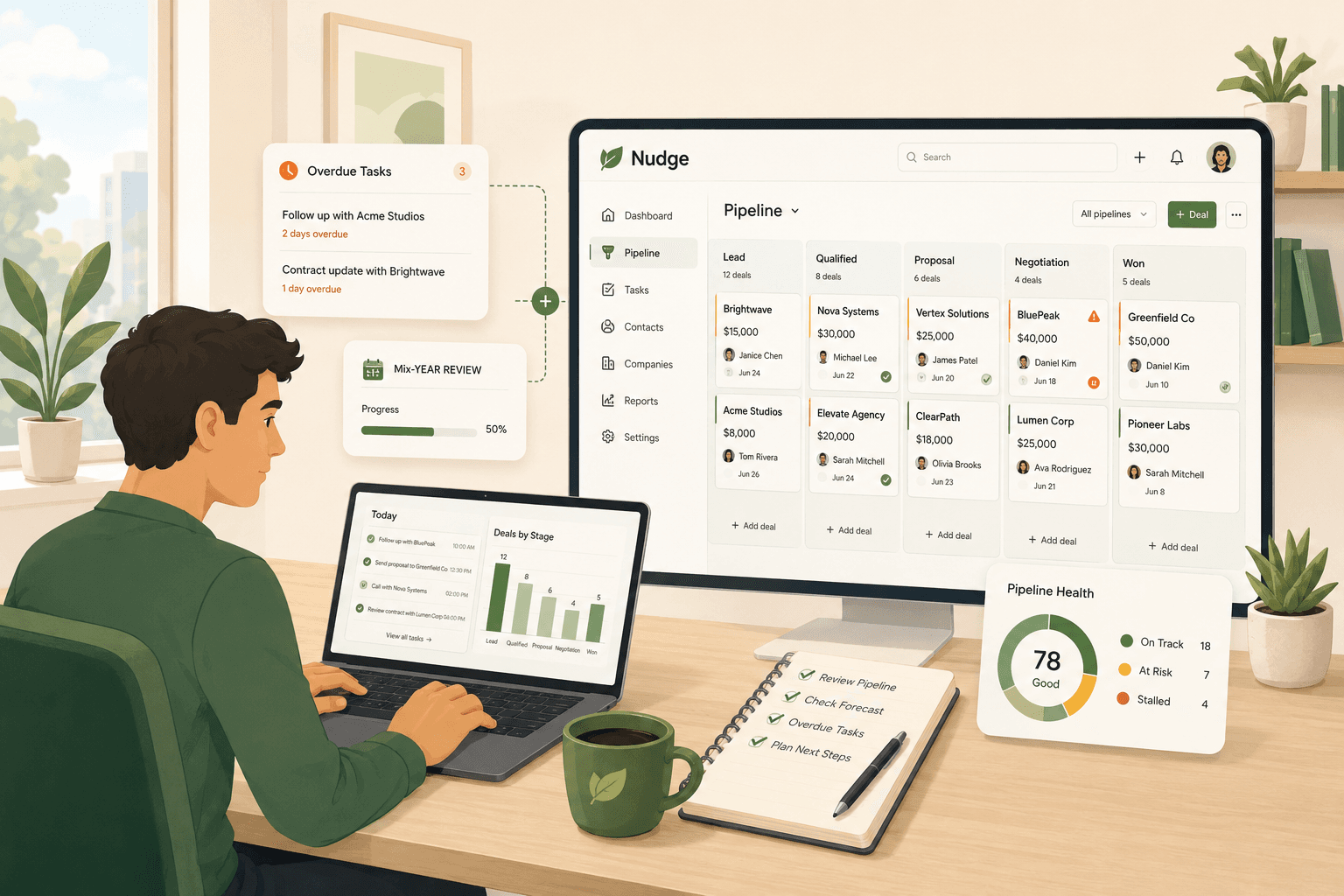
The halfway point of the year is one of the best times to step back and look at your sales pipeline with fresh eyes.
It's easy to focus on revenue goals, new opportunities, and closing deals. But without a regular pipeline review, small issues quietly grow into bigger problems. Deals stop moving. Follow-ups are forgotten. Forecasts become less reliable. By the end of the year, you're left wondering where all the momentum went.
A mid-year pipeline review isn't about creating another report. It's about making sure every opportunity has a realistic chance of moving forward.
Here are seven questions every sales team should ask before starting the second half of the year.
1. Which deals haven't moved recently?
A full pipeline isn't necessarily a healthy pipeline.
Start by identifying opportunities that haven't had any meaningful activity in the last few weeks. If a deal has remained in the same stage for a long time with no emails, meetings, calls, or updates, it's worth investigating.
Ask yourself:
- Has the customer gone quiet?
- Are we waiting on something internally?
- Has this opportunity simply been forgotten?
Some of these deals deserve renewed attention. Others may need to be removed from the forecast altogether.
Cleaning up inactive opportunities gives you a much more accurate picture of your pipeline.
2. Does every active deal have a clear next step?
One of the most common reasons deals stall is because nobody knows what should happen next.
Every opportunity should have one clearly defined next action.
Examples include:
- Schedule a discovery call
- Send a proposal
- Follow up after a demo
- Review pricing with the customer
- Prepare a contract
If the next step isn't obvious, chances are it won't happen.
Clear next actions create momentum and make it much easier for both sales reps and managers to understand what's happening across the pipeline.
3. Is every deal assigned to one owner?
Ownership creates accountability.
Every active deal should have one person responsible for moving it forward.
When ownership is shared across multiple people, it's surprisingly easy for important follow-ups to fall through the cracks because everyone assumes someone else is handling them.
During your review, check for:
- Deals without an owner
- Ownership that no longer reflects the current salesperson
- Shared responsibilities that aren't clearly defined
One owner doesn't mean one person does everything. It simply means everyone knows who is responsible for making sure the deal continues to move.
4. How many follow-ups are overdue?
Follow-up delays are one of the earliest warning signs of an unhealthy pipeline.
Review your outstanding activities and look for patterns.
Questions to ask include:
- How many follow-ups are overdue?
- Which sales reps have the largest backlog?
- Are overdue tasks concentrated in certain pipeline stages?
- Are reminders being ignored?
The goal isn't to blame anyone.
It's to identify bottlenecks before they become lost revenue.
Small delays become much harder to recover from when they accumulate over several months.
5. Are your forecasts based on reality?
Every sales team has deals they hope will close.
The challenge is separating optimism from evidence.
Review each major opportunity and ask:
- Has the customer engaged recently?
- Is there a confirmed buying timeline?
- Have key stakeholders been identified?
- Is there a scheduled next conversation?
If the answer to several of these questions is no, that opportunity may not belong in this quarter's forecast.
Removing unrealistic deals improves planning and helps the team focus on opportunities that can actually close.
6. Does your pipeline still match your sales process?
Sales processes change over time.
New services are introduced. Buying cycles evolve. Teams grow.
If your pipeline hasn't changed with your business, it may no longer reflect how your team actually sells.
Look for signs such as:
- Stages that nobody uses
- Deals skipping multiple stages
- Stages that contain very different types of work
- Confusion about when deals should move
A pipeline should make work easier, not create unnecessary administration.
Simple, clearly defined stages usually produce better visibility than overly complicated workflows.
7. Can everyone see what needs attention today?
A good pipeline doesn't just show where deals are.
It helps the team understand what needs attention right now.
Managers should be able to answer questions like:
- Which deals need immediate follow-up?
- What's overdue today?
- Which opportunities are at risk?
- Who needs support?
If answering these questions requires several spreadsheets, reports, or meetings, your sales process probably has unnecessary friction.
The easier it is to identify priorities, the easier it is to keep deals moving.
Turning Your Review Into Action
Once you've completed your review, don't let it become another document that nobody reads.
Create an action plan.
You might decide to:
- Archive inactive opportunities.
- Assign missing owners.
- Add next steps to every active deal.
- Complete overdue follow-ups.
- Simplify your pipeline stages.
- Schedule a weekly pipeline review instead of waiting another six months.
Small improvements made consistently are much more valuable than one major cleanup each year.
How Nudge Helps Keep Pipelines Healthy
Most CRMs allow deals to exist without clear ownership, next steps, or due dates.
Over time, that leads to stale pipelines and unreliable forecasts.
Nudge was built differently.
Every deal requires:
- An owner
- A next step
- A due date
Instead of discovering problems during quarterly reviews, teams always know what's overdue, what needs attention today, and which deals are at risk.
That creates a healthier pipeline with less manual oversight and fewer forgotten opportunities.
Final Thoughts
A mid-year pipeline review isn't about checking boxes.
It's about giving your team confidence that every active opportunity has a clear path forward.
The healthiest pipelines aren't the ones with the most deals.
They're the ones where every opportunity has an owner, a next step, and enough momentum to keep moving.
Take an hour this week to ask these seven questions.
Your future pipeline will thank you.